



With AI search now accounting for ~10–15% of search discovery, visibility in AI search engines is quickly becoming a new marketing channel.
In the industry, there are already plenty of “audits” for scanning and optimization of a specific topic, such as a content or SEO audit.
Since the AI search is growing, guess what? The industry needs an AI search audit focused on practices to optimize your website for AI search visibility.
In this guide, we will go through the main things to take care of if you want to see your website being mentioned in LLM answers.
Let’s dive in!
Why is AI Search Audit Important?
Search is fracturing. ChatGPT, Perplexity, and other AI search engines are pulling traffic that used to flow through Google. For many sites, these platforms already drive meaningful referral numbers.
The opportunity window is still open. Unlike traditional search, where decades of competition have made ranking difficult, the rules for appearing in LLM responses are still being written. Early movers can establish a presence before the space becomes saturated.
There’s a catch: most AI search engines still rely heavily on traditional search rankings as trust signals. Your Google and Bing positions matter. But they’re not the only factor anymore.
Sites that understand the distinct requirements of LLM citations, structured data, clear context, and quotable insights are seeing results even without top-three SERP positions.
The question isn’t whether to adapt. It’s whether you’ll do it while there’s still room to move.
AI Search Visibility Audit: 3 Actionable Practices To Follow
Google has been on the market for more than 20 years; based on that, the best practices of what you should optimize on your website to rank in SERP are well known to everybody.
But, since the AI search engines are relatively new on the market, optimizing websites for getting mentioned in LLMs is still new and expanding by analyzing what is ranking well inside the conversational search.
Here are the 3 crucial things to consider while you are doing an audit for your website:
1. Verify Crawler Access in Robots.txt
Manually check the robots.txt file of your website (file is placed on the root domain of your website, e.g., “omnius.so/robots.txt”), ensure that under the “Disallow:” command, there is no “AI search Bot”, such as:
- GPTBot (OpenAI)
- ClaudeBot (Anthropic)
- Meta‑ExternalAgent (Meta)
- OAI‑SearchBot (OpenAI)
- PerplexityBot (Perplexity)
If you have a blocking command in the robots.txt file for any of these blocks, delete the whole part (for example, “Disallow: GPTBot” – delete it).
Check Cloudflare Settings
By default, websites connected to the Cloudflare system will have AI search engines blocked for both searching and training, which should be changed in the Cloudflare settings.
If you see something like this in your robots.txt file, it’s from Cloudflare:
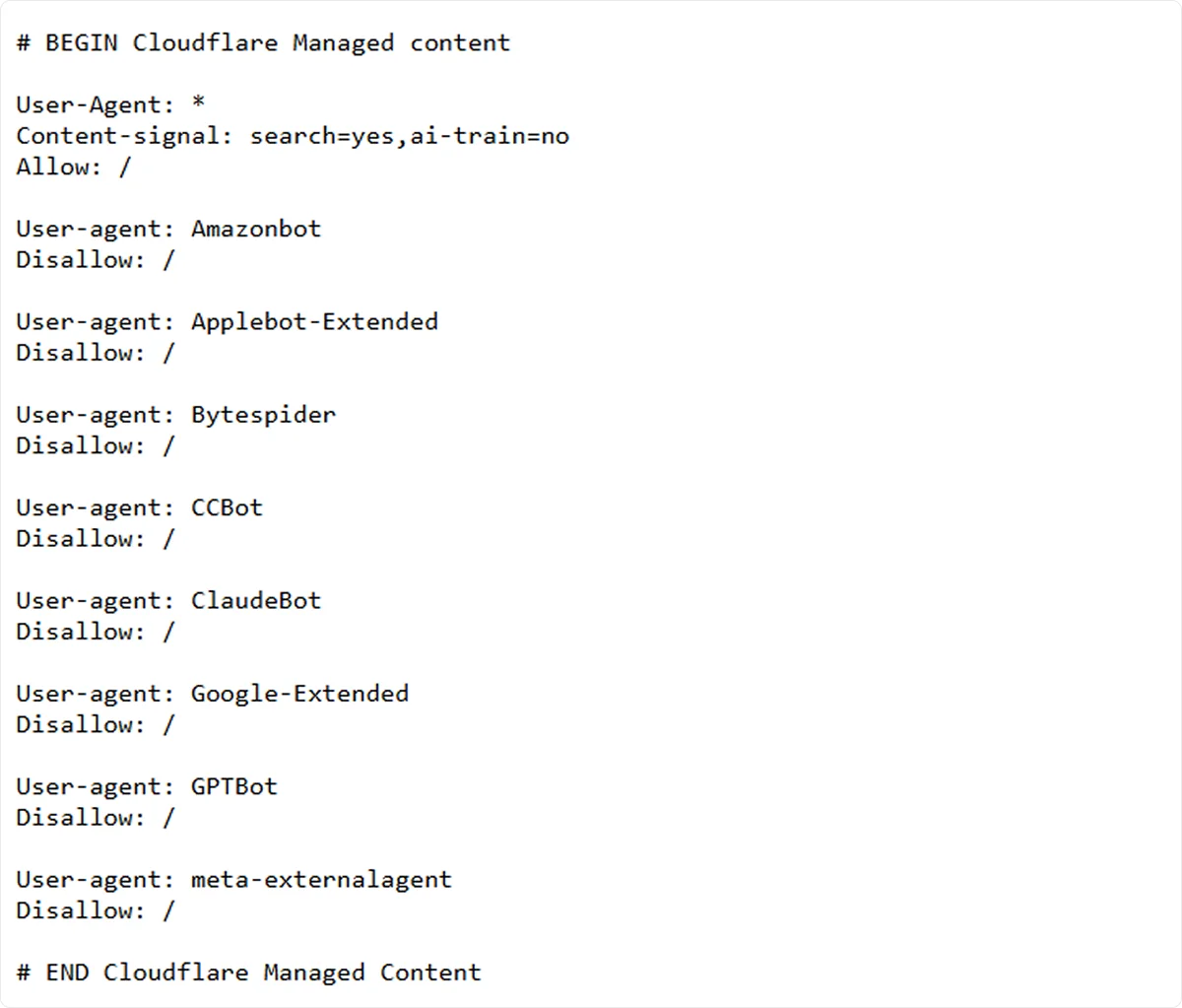
To fix this, change the settings in your Cloudflare dashboard under Bots > Configure Super Bot Fight Mode, and disable the AI crawler blocking option.
In 2025, the most blocked bot on the internet is the ChatGPT crawler bot. A lot of those websites currently have disallow commands for AI search bots without their knowledge or consent, so make sure to check this and remove it if you want to see your website in LLM responses.
2. Establish Current AI Visibility
If your crawlers aren’t blocked, you’re likely already appearing in some LLM responses. The question is: where, how often, and for what queries?
1. Set up tracking
For checking AI search visibility metrics, you can set up manual tracking in Google Analytics 4 or use AI search monitoring tools such as AtomicAGI, Semrush, or Ahrefs.
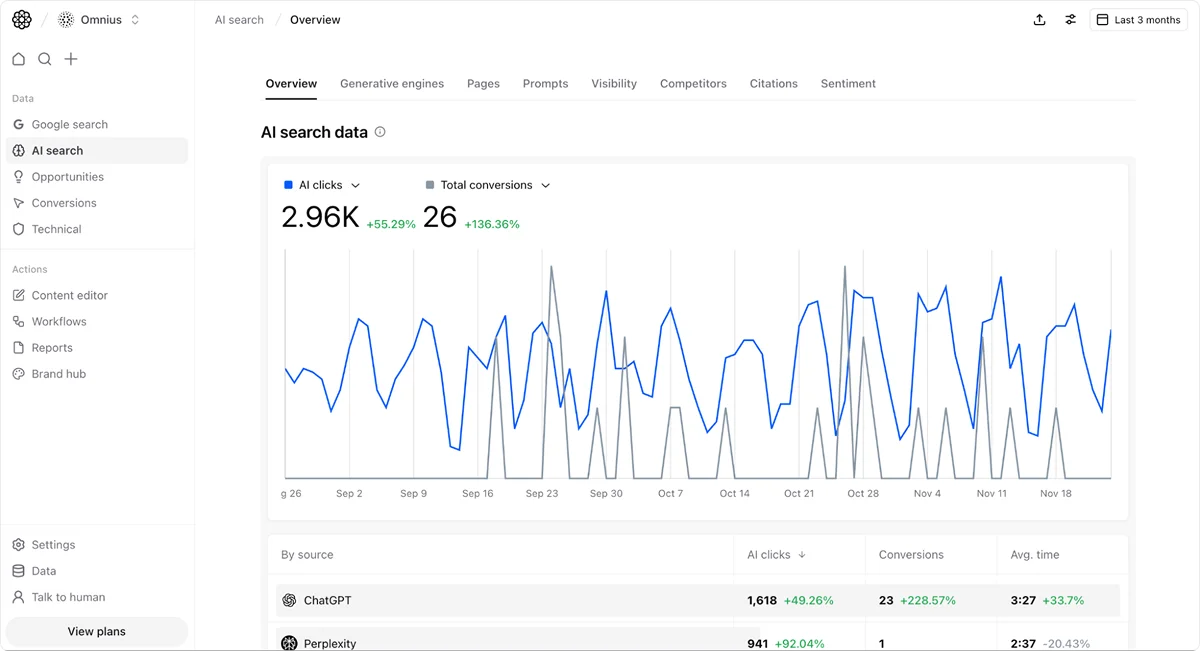
For tracking AI search specifically, AtomicAGI gives you a dedicated dashboard to monitor citations across ChatGPT, Perplexity, and other AI platforms.
Choose the option that works best for you and start measuring your performance.
2. Map your current footprint
Once you have AI search visibility data, create three lists:
- Pages that get cited – Note which queries trigger these citations
- High-value pages with zero citations – These are your optimization targets
- Queries you want to own – Compare against where you actually appear
3. Identify your citation patterns
Look for patterns in what’s working. Are your cited pages longer or shorter? Do they include specific data points, examples, or formatting? Are they definition-focused or solution-focused?
Compare your top-cited page against your zero-citation pages. The gap often reveals what answer engines value: direct answers in the first 200 words, clear problem-solution structure, or specific data that other sources lack.
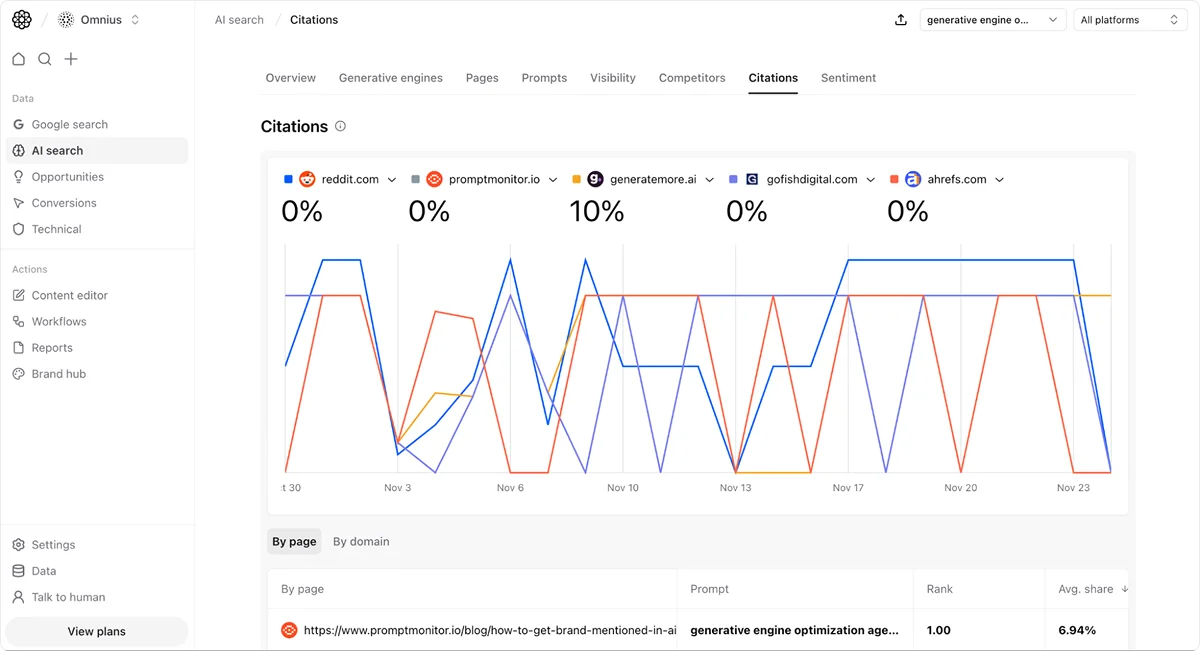
This isn’t about mimicking what works elsewhere. It’s about understanding what makes your existing content citation-worthy, then replicating those elements across pages that matter but aren’t performing.
3. Run Manual Prompt Tests in LLMs
Data tools show patterns, but manual testing reveals how answer engines actually represent your brand. Run 15-20 test queries across ChatGPT, Perplexity, and Gemini.
Non-branded queries (10-15 tests):
- Comparison searches: “Asana vs Monday vs (your product)”
- Alternative searches: “alternatives to (competitor)”
- Category searches: “best project management tools for remote teams”
- Problem-focused searches: “how to automate task assignments”
Branded queries (5 tests):
- Direct: “What is (your company)?”
- Evaluative: “Is (your company) worth it?”
- Comparative: “(Your company) vs (competitor)”
Evaluate the results
Check three things in each response:
- Presence – Does your site appear at all?
- Accuracy – Is the information correct and current?
- Tone – Is the framing neutral, positive, or negative?
If results are accurate and favorable: Your site is accessible, your content is clear, and external sources validate your positioning. You’re in good shape. Focus on expanding coverage to more queries.
If results are inaccurate or negative: Two likely causes:
Access issues – Answer engines can’t properly crawl your site. Review your robots.txt again, check for JavaScript-heavy pages that block content, and ensure key information appears in clean HTML.
Reputation gaps – External sources (reviews, forums, social mentions) skew negative. Note every source cited in the responses.
Address negative citations:
- Document the sources – List every site, review platform, or forum mentioned
- Contact directly – For factual errors or outdated reviews, reach out to site owners or platform support
- Fix the root issue – If multiple sources mention the same problem, that’s a signal to improve your product or service
- Build counter-evidence – Encourage satisfied customers to leave reviews on the same platforms where negative feedback exists
Don’t try to game the system by flooding platforms with fake positive reviews. Answer engines pull from multiple sources, manipulation is detected, and it further damages trust.
That said, doing this manually works for your first audit, but repeating 15-20 queries across multiple platforms every month gets time-consuming fast.
Tools like AtomicAGI automate this monitoring, tracking your presence, accuracy, and citation changes without requiring you to run the tests each time.
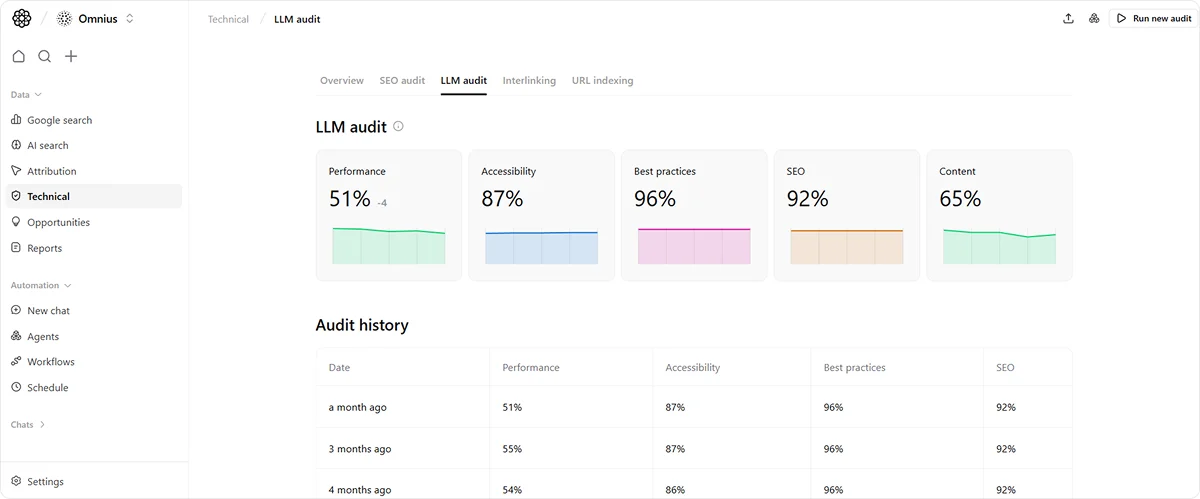
8 Best Implementation Practices for AI Search Visibility
Once you’ve mapped your current AI search visibility, shift to strengthening the signals that answer engines rely on.
1. Deploy Structured Data
AI search bots, like traditional search bots, use structured data to understand page context and content type.
Add schema markup appropriate to your pages depending on your structure:
- Organization schema – Company name, logo, contact info, social profiles
- Article schema – Published date, author, headline (critical for news/blog content)
- Product schema – Price, availability, reviews, specifications
- FAQ schema – Question-answer pairs that often get pulled directly into responses
- HowTo schema – Step-by-step instructions with clear formatting
Use schema markups accurately according to the schema, so Google can recognize them.
Test your implementation with Google’s Rich Results Test. If Google can read it, LLM bots can too.
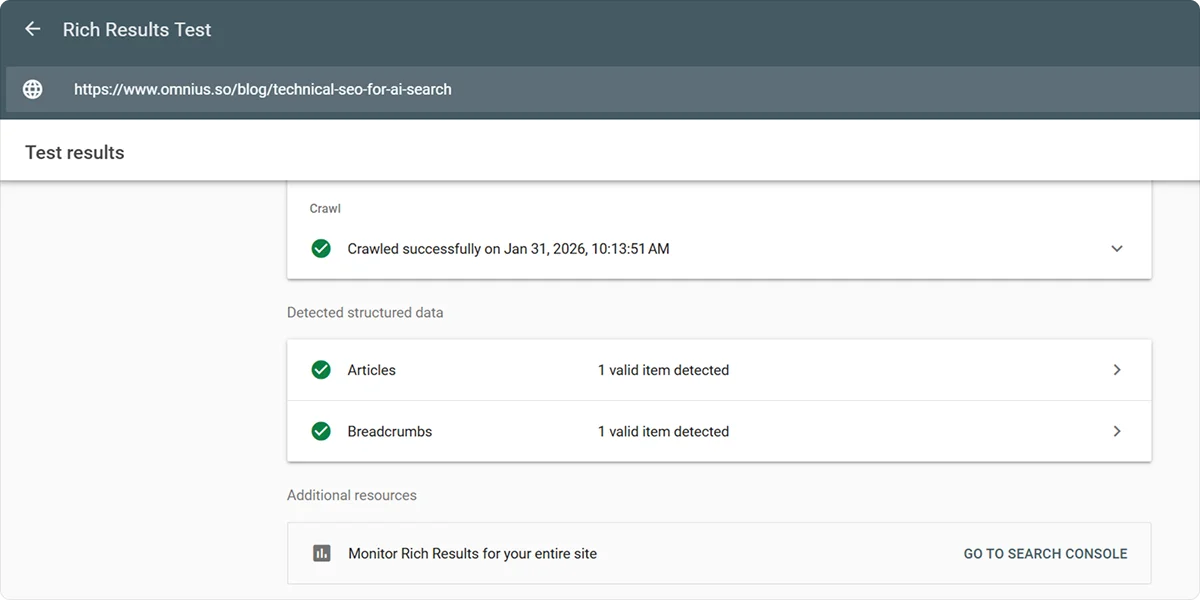
If you encounter any errors, fix them and test again.
2. Optimize Content
Target the high-value pages from your audit, the ones that should appear but don’t.
Structure for scannability:
- Keep sections under 250 words before the next heading
- Lead with the answer in the first paragraph
- Use descriptive headings that could work as standalone statements and also have search volume
Refresh regularly:
- Update statistics every quarter
- Replace outdated examples with current ones
- Add new developments in your field as they happen
Include FAQ sections: Answer engines frequently extract from FAQ blocks. Add 5-8 questions that match how people actually ask about your topic.
3. Build External Validation
AI search engines don’t just look at your website; they weigh external mentions heavily.
Digital PR and Media placements
Get featured in industry publications, news sites, or research roundups. Two approaches work:
- Thought leadership – Publish original research, data analysis, or trend reports that journalists reference
- Expert commentary – Respond to journalist requests on platforms like HARO, Terkel, or Featured
Critical Framing Rule
When your brand appears in articles, ensure it’s introduced with a business context.
Weak: “This led to the creation of Omnius.” Strong: “This led to the creation of Omnius, an SEO agency specializing in SaaS and Fintech.”
LLMs use these descriptors to understand what you do. Without them, you’re just a name.
Backlink acquisition
Focus on topic-relevant links from established sites in your space. One link from an authoritative source in your niche outweighs ten generic directory listings.
4. Expand Topic Coverage
Single pages rarely dominate answer engine results. Comprehensive topic coverage does.
Build content clusters around your core topics:
- Main pillar page covering the broad topic
- 8-12 supporting pages addressing specific angles, questions, or subtopics
- Internal links connecting related pages bidirectionally
5. Apply the query fan-out strategy
To rank for a main query, you need surrounding content that covers related searches. This is called “query fan-out”, expanding from your core topic into the natural questions and comparisons people make around it.
Example: If you want visibility for “AI coding agents,” create supporting content for:
- Evaluative queries: “best AI coding agents 2025”
- Comparison queries: “Devin vs GitHub Copilot Workspace vs Cursor”
- Categorical queries: “autonomous coding agents for software development”
- Use case queries: “AI coding agents for Python development”
LLMs pull from content that demonstrates topic authority across multiple angles. Pages that only target exact-match queries get cited less often than those connected to a broader content ecosystem.
6. Signal Recency
Answer engines favor current information. Simple signals help:
- Add “2025” or “2026” to title tags and H1s where relevant
- Include “Last updated: (date)” stamps on evergreen content
- Reference recent events, data, or product versions in your copy
Don’t fake recency; if the content is outdated, update it properly or remove it. AI search engines will not take your information if it’s outdated, even if you claim it’s not.
7. Maintain Focus
Each website should center on one clear entity or topic. Mixed messaging confuses both traditional search and AI search engines.
If a page covers three different niche products or concepts, split it into three focused websites. Clarity beats comprehensiveness when LLMs decide what to cite.
8. Ensure Clean Content Rendering
AI search crawlers don’t always execute JavaScript the way browsers do. If critical content lives behind JavaScript rendering, it might be invisible to crawlers.
To get the most similar preview of how AI search bots see your page, you can use Google Search Console’s URL Inspection tool:
- Paste any important page URL
- Click “Test Live URL”
- View the rendered HTML and visual preview
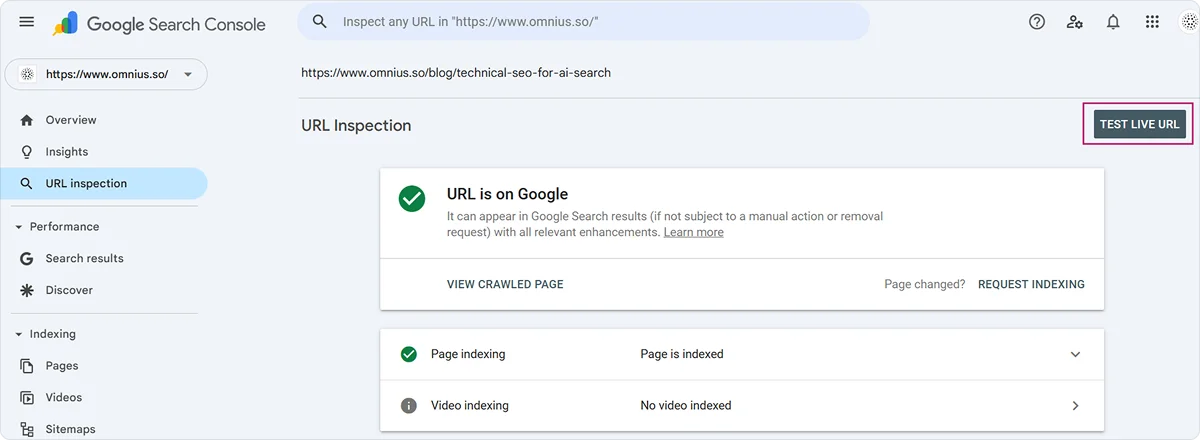
Compare what the crawler sees against what visitors see. Focus on the main body content, headings, product descriptions, and FAQ sections. If content appears in your browser but not in the crawler view, you have a rendering problem.
Fix rendering issues
The most reliable solution: serve essential content in plain HTML. Save JavaScript for interactive elements, not core information.
Priority fixes that matter for crawler access:
- Move text content from JavaScript variables into HTML tags
- Render headings, paragraphs, and lists server-side
- Ensure structured data appears in the initial HTML response
Meanwhile, animations, interactive calculators, and navigation enhancements can safely remain in JavaScript.
If you’re running a React, Vue, or similar framework, implement server-side rendering (SSR) or static site generation (SSG) for content pages. This gives crawlers immediate access while preserving your interactive features.
The rule: if you want it cited in an LLM response, crawlers need to see it without executing code.
Conclusion
Run this audit monthly or quarterly to track your progress and identify new opportunities.
Once you complete your first AI search audit, use the findings to build your GEO strategy for the next 6-12 months, prioritize fixes based on impact, set measurable visibility goals, and schedule regular content updates.
The sites that start optimizing now will shape how LLMs understand their category before competitors. Block off time this week to work through the checklist, identify your three highest-impact improvements, and begin implementation.
If you struggle with the implementation process, you can hire a GEO agency such as Omnius to handle the optimization for you.
FAQs
How often should I audit my AI search presence?
Perform audits monthly or quarterly based on your needs. After each audit, implement a corrective strategy addressing identified issues. Once fixes are deployed, run another audit to verify improvements and measure impact. This cycle ensures continuous optimization and maintains strong AI search visibility across platforms.
What’s the difference between AI Search Audit and SEO Audit?
AI Search Audit examines how your content performs in AI-powered platforms like ChatGPT, Perplexity, and Gemini, focusing on citations, answer accuracy, and LLM visibility. SEO Audit targets traditional search engines, analyzing rankings, backlinks, and technical factors.
Nguồn: omnius.so