




In July 2025, a major shift occurred in how ChatGPT, OpenAI’s popular conversational AI, drives traffic to external sites. Referrals from ChatGPT dropped by about 52% after July 21, 2025.
The sudden decline raised immediate questions: had users stopped using ChatGPT? Was it linked to the launch of GPT-5? Or was something less visible happening behind the scenes?

Follow-up reports clarified that ChatGPT usage actually grew month over month in July 2025 and continued to rise year over year. The fall in outbound clicks wasn’t due to declining demand but to changes in ChatGPT’s retrieval-augmented generation (RAG) system, which shifted how it selects and cites sources.
This report looks at what happened, why it matters, and what it tells us about the fragility of AI-driven referral traffic.
Why this matters
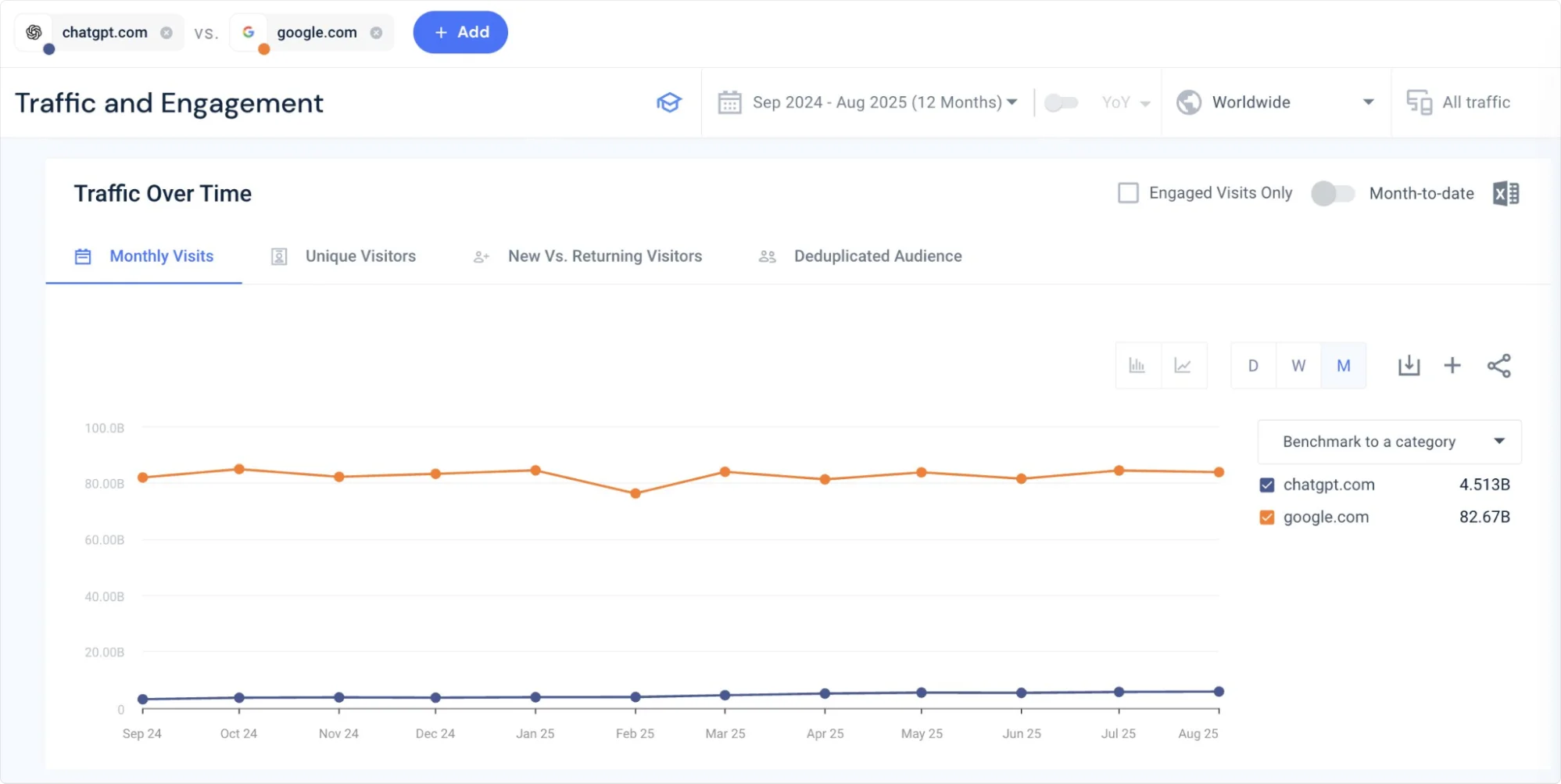
Since launching publicly in 2022, ChatGPT has become one of the world’s most visited websites. By July 2025, it ranked among the top ten globally, with around 5.7 billion monthly visits. It also became a meaningful, though still relatively small, source of referral traffic for publishers and brands. The July referral crash shows how even small technical changes in AI systems can dramatically reshape web traffic patterns.
For marketers, this isn’t just another data point. It’s a warning: relying on a single platform is risky. GEO (Generative Engine Optimization) can deliver incremental gains, but just like SEO and social media before it, it’s vulnerable to sudden platform changes. The only real safeguard is diversification.
ChatGPT’s rapid growth and its place in the web
Usage growth
According to Similarweb, ChatGPT’s monthly visits grew from 2.6 billion in July 2024 to about 5.7 billion in July 2025, an increase of roughly 117% year over year. Even with some plateauing in spring 2025, the platform still posted 6% month-over-month growth in July. This put it behind only a few giants like Google, YouTube, and Facebook in total traffic. The +135% year-over-year growth rate also made ChatGPT one of the fastest-growing websites worldwide in July 2025.

Comparing referrals to search engines
Despite its size, ChatGPT sends far fewer visitors to external sites compared with traditional search engines. A TechCrunch summary of Similarweb data reported that all AI platforms combined drove about 1.13 billion referral visits in June 2025, up 357% year over year. By contrast, Google Search sent around 191 billion referrals in the same month. Even after rapid growth, AI referrals represented less than one percent of Google’s volume.
ChatGPT dominates within the AI category, accounting for over 80% of AI referrals (ranging from 81 to 95 percent depending on the source). But its overall contribution to web referrals is still tiny.
Ahrefs’ AI traffic tracker paints a similar picture: by mid-2025, ChatGPT generated only about 0.19% of total referral traffic across the web, while Google’s share was roughly 41.9%. ChatGPT’s referrals did grow 5.3% month over month, but the scale gap remains enormous.
Google’s lead is overwhelming, and while ChatGPT’s share signals where the market might be heading, it is still minuscule compared to established search engines.
Even with triple-digit growth in AI referrals (+357% year over year to 1.13B in June 2025), Google’s ~191B referrals in the same period dwarf the numbers. ChatGPT’s global share sits at just 0.19%, versus Google’s ~42%. GEO may look promising on trend charts, but the scale difference makes over-reliance extremely risky.
Understanding referral vs usage trends: usage and clicks decouple
The July referral crash happened at a time when usage and outbound clicks were moving in opposite directions. On one side, ChatGPT usage continued to grow. On the other, outbound referrals collapsed. This unusual split suggested a systemic change inside the platform rather than a shift in user behavior.
The contrast is clear when you line up the numbers:
- Referrals: Down 52% within weeks (Profound, 1B citations, 1M visits)
- Usage: Up 6% month over month in July, reaching 5.7B visits (Similarweb)
- Growth: +135% year over year made ChatGPT one of the fastest-growing sites globally in July 2025
- Abandonment: Pew found that sessions with AI summaries had a 26% abandonment rate versus 16% without summaries
The wider trend reinforces the point. Google’s AI Overviews have shown a similar effect, driving much lower click-through rates. Studies found that only about 8% of users click when AI summaries appear, compared to 15% without them. Research from The Guardian and Pew confirms this pattern, with news publishers hit especially hard: zero-click rates in news searches jumped from 56% to 69% within a year.
The data behind the crash
The first in-depth analysis of the referral drop came from Profound, an analytics firm that tracked more than 1 billion ChatGPT citations and 1 million outbound visits. Profound’s lead researcher, Josh Blyskal, published detailed charts showing that referrals from ChatGPT fell by about 52% between July 21 and the end of August 2025. Trade publications including Search Engine Land, PPC Land, MediaPost, and Search Engine Journal later reported on these findings.
Citation concentration in a few domains
After July 21, citations from ChatGPT clustered heavily around a handful of sites. References to Reddit rose by about 87 percent and Wikipedia by roughly 62 percent, while TechRadar also gained visibility. Together, these three domains captured around 22 percent of all citations, a 53 percent increase compared with the previous month.
Profound’s dataset shows the July decline wasn’t about users leaving ChatGPT, but about how OpenAI adjusted citation weighting:
- Reddit citations grew 87%, representing over 10% of all ChatGPT links
- Wikipedia citations rose 62%, taking a 13% share
- With TechRadar included, the top three domains held 22% of all citations, up 53% in one month

Long-tail publishers lost visibility
The surge in citations to Wikipedia, Reddit, and TechRadar came at the expense of thousands of smaller publishers. Sites that had previously been cited occasionally saw their presence nearly vanish after the reweighting. The result was a “winner-takes-more” pattern, where a small set of large, generalist sources dominated citations. Fewer links appeared per answer, and far fewer domains were represented. Smaller publishers lost visibility almost overnight.
Why referrals collapsed: a look at RAG and citation weighting
What is retrieval-augmented generation?
ChatGPT doesn’t generate answers purely from its internal model. It often uses a retrieval-augmented generation (RAG) system. RAG works in three steps: a retriever fetches relevant documents from an external corpus, a re-ranker scores them, and then the generator integrates the selected passages into a response. The final stage is attribution, where citations or links are displayed when required.

Inside the RAG change: why citations collapsed
The July adjustment wasn’t tied to GPT-5’s release or to falling usage. It was about how ChatGPT’s RAG system retrieves and reweights sources.
In late July 2025, OpenAI appears to have adjusted the weights used during retrieval and re-ranking. Sources seen as more “answer-first,” like Wikipedia and Reddit, were given more prominence, while niche or brand-specific content was deprioritized. Since ChatGPT usually cites only a few sources per answer, boosting a small set of sites reduces overall diversity. That’s why citations from thousands of smaller publishers vanished.
The results were immediate:
- Outbound clicks fell 52% because fewer links were displayed, many pointing to the same domains
- Citation diversity collapsed, cutting visibility for thousands of sites
- Referral power concentrated, with three domains capturing nearly a quarter of all links
This change happened at the retrieval stage – not because a new model had different knowledge, and not because user demand dropped. It was essentially a dial turned toward “prefer Wikipedia and Reddit results.” Once adjusted, fewer alternative sources were retrieved, ranked, and displayed. A tweak in re-ranking could have produced the same outcome, favoring direct definitions over narrative context. Either way, the effect was a narrower citation pool.
Unlike SEO, where authority builds over time through backlinks and relevance, RAG-driven referrals are engineered. A single adjustment in retriever or re-ranker weights can redraw the referral landscape in days.
One nuance: RAG systems often give preference to fresh statistics and unique datasets. Sites publishing benchmarks, updated reports, or original research are more likely to appear. But this edge is temporary and depends entirely on the next weighting change.
In short: the July collapse was the result of a retrieval adjustment, not a demand problem.
Impact on long-tail publishers
Because ChatGPT’s citations determine which sites receive AI-driven referrals, the July changes carried serious consequences for publishers, marketers, and researchers. Before the adjustment, many smaller publishers benefited from AI referrals, since ChatGPT drew from a wide variety of sources. Afterward, their content was effectively invisible, while generalist (Wikipedia) and community-driven (Reddit) sources dominated.
This shows a key difference between GEO and SEO. SEO is built on relatively stable signals like backlinks and content quality. GEO, by contrast, relies on retrieval heuristics that can shift quickly. That makes AI-driven visibility (currently) unstable.
Broader patterns: algorithmic shifts and traffic volatility
The ChatGPT referral crash may feel unusual, but it fits a well-established pattern: distribution systems powered by algorithms often make abrupt changes that dramatically alter who gains and who loses. Every major platform has gone through similar shifts:
- Facebook (2018 onward): Publisher traffic from Facebook fell from about 30% in the mid-2010s to the low single digits by 2024, after the platform prioritized posts from friends and family. Some smaller outlets lost more than 90% of their Facebook-driven traffic.
- Reddit’s API and ecosystem changes (2023–2024): New API pricing disrupted third-party apps and reshaped referral patterns almost overnight. Some communities locked down, cutting off traffic sources.
- Google core updates: Even before AI overviews, Google’s periodic updates routinely reshaped rankings. The June 2025 Core Update, for example, left some sites with traffic gains of 50% or more, while others lost half their visibility in a single update.
The cycle is predictable: rapid growth, over-investment, then retrenchment. The July ChatGPT crash was simply another round of this cycle, applied to AI search engines.
The lesson is clear. Relying on any single distribution channel – whether Facebook in 2018, Reddit in 2023, or ChatGPT in 2025 – exposes publishers to volatility beyond their control. Growth on these platforms can be real, but it can also vanish with little warning. The takeaway isn’t to avoid investing, but to avoid concentrating too heavily in one place.
Risk diversification through multi-engine SEO
Search isn’t disappearing, but diversifying across multiple engines is the best hedge. Expanding beyond Google into AI-driven platforms like ChatGPT, Perplexity, Claude, and Gemini, and spreading efforts across different formats such as community content, video, structured data, and original research, helps reduce exposure to sudden shifts.
SEO and GEO shouldn’t be treated as separate strategies. They form a single system: SEO ensures eligibility, while GEO improves citation share within AI engines. Managing them together, across multiple platforms, is the only sustainable way forward in an environment where a single dial change can reshape traffic overnight.
Implications for companies
Scale matters – but so does volatility. In June 2025, ChatGPT sent around 1 billion referral visits to the top 1,000 domains, accounting for more than 80% of all AI referrals. Impressive as that is, it’s still tiny next to Google’s 191 billion referrals. Even with fast growth, AI referrals represent only a small slice of overall web traffic.
Retrieval bias is real and subject to change. The crash showed that AI engines don’t cite sources purely on merit. Their choices reflect engineering decisions about what counts as an “answer.” In July, the system tilted toward encyclopedic and community sources. In the future, it could just as easily tilt toward fresh data, licensed material, or paywalled content.
Authority works differently in generative engines. In SEO, backlinks and domain strength build over years. In AI systems, “authority” comes from retriever and re-ranking rules, which can shift overnight. AI visibility should be treated as experimental and supplementary, not as a replacement for proven channels.
High-quality, structured information is still valuable. Even when weighting changes, ChatGPT favors sources that give clear, concise answers. Sites with well-defined summaries, FAQs, and original data are more likely to appear when the retrieval system rewards those traits. The July adjustment elevated sites seen as widely authoritative, like Wikipedia.
Diversification is essential. No single platform should be relied on for traffic. Spreading efforts across search engines, social channels, newsletters, and direct communities helps reduce the impact of sudden algorithmic changes. This principle has always applied to SEO and social, and now it applies to generative search as well.
Conclusion
The July 2025 ChatGPT referral crash is a cautionary case for the growing field of generative engine optimization. A single adjustment in OpenAI’s retrieval system cut outbound clicks by half within weeks. The decline wasn’t caused by fewer users; usage actually grew to about 5.7 billion visits in July, and it wasn’t tied to GPT-5’s release. The drop came from changes in how ChatGPT retrieved and weighted sources, favoring “answer-first” domains like Wikipedia and Reddit.
This episode highlights how sensitive AI referral traffic is to engineering choices. For publishers and brands, it’s important to view these shifts in context: AI referrals are growing quickly, but they remain small compared to traditional search. Participating in generative search has value, but it should be treated as an experiment rather than a foundation for audience growth.
The practical response is diversification. A balanced strategy spans search engines, social platforms, newsletters, and direct audience relationships. Generative search can be part of that mix, but not the core. Only by treating AI referrals as one piece of a broader, diversified approach can brands manage the volatility of AI-driven web traffic.
At Omnius, we help brands future-proof their digital strategies. Book a free 30-minute call to explore how we can build a diversified, resilient growth plan for your business.
Nguồn: omnius.so